


Quick Summary Who This Is For
Key Takeaways
|
Welding inspection is the structured process of evaluating welds before, during, and after fabrication to confirm they meet defined quality standards and applicable codes. For trailer manufacturers, structural fabricators, and anyone operating in a regulated welding environment, a disciplined inspection program is not optional. Structural integrity depends on it.
This guide is written for fabrication professionals, quality managers, certified welding inspectors, and project engineers who need a reliable reference that spans the full inspection lifecycle. It draws on requirements set by the American Welding Society (AWS), ASME International, ASTM, and ASNT SNT-TC-1A. Applicable codes include AWS D1.1 for structural steel welding, AWS D1.5 for bridge welding, and ASME Section IX for pressure-related procedure qualifications. Any specific project will reference its own governing standard, and inspectors should confirm the applicable code before work begins.
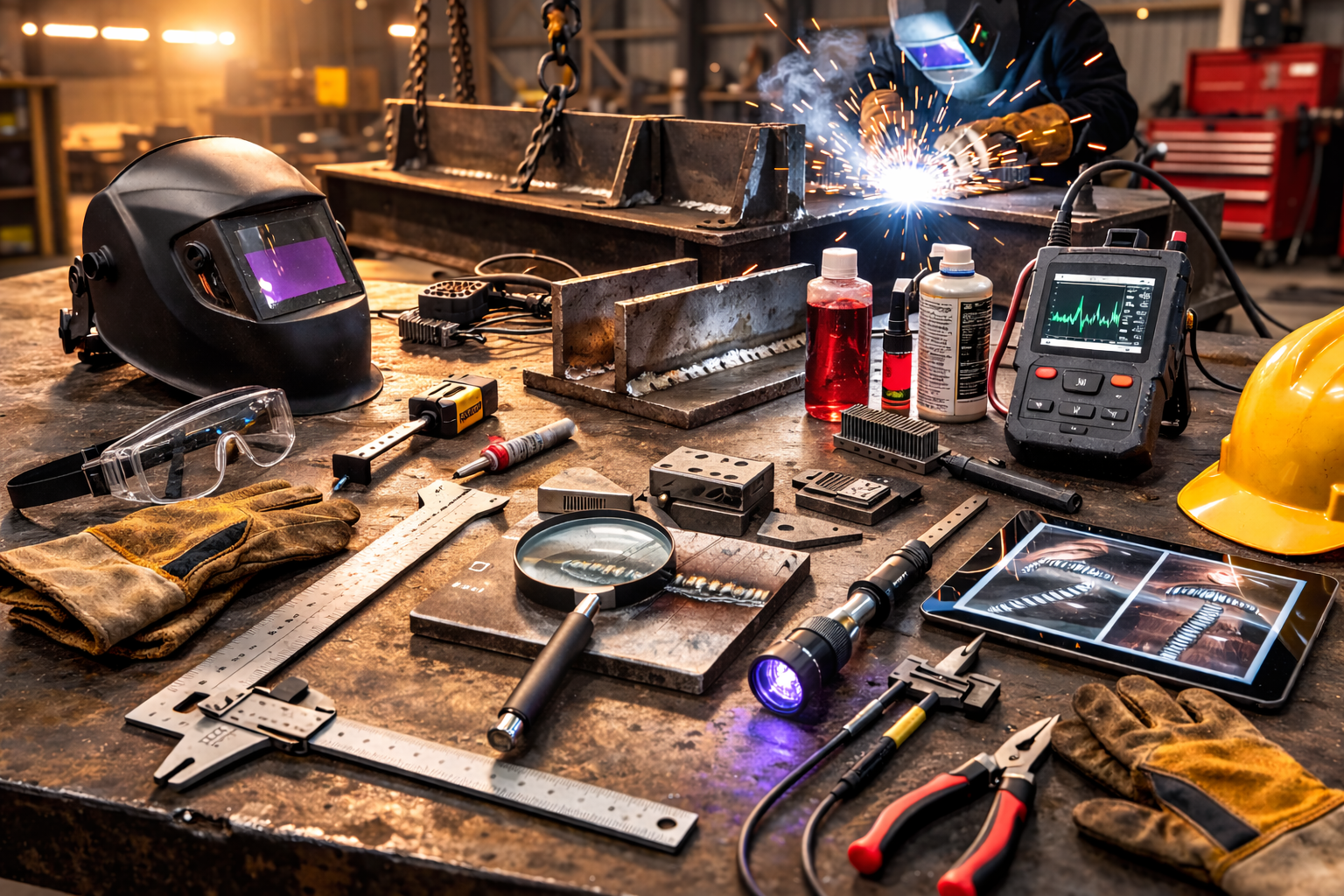
Nondestructive Testing vs. Destructive Testing
Every welding inspection program combines two broad categories of evaluation: nondestructive testing (NDT) and destructive testing (DT). Understanding the difference between them determines how you plan your inspection scope and what documentation you need to retain.
Nondestructive testing examines a weld without altering or damaging the component. Visual weld inspection, ultrasonic testing, magnetic particle inspection, liquid penetrant testing, and eddy current testing all fall into this category. The key advantage is that production welds remain usable after examination. NDT is the default choice for inspecting welds on finished components, in-service structures, and situations where the part cannot be sacrificed.
Destructive testing, by contrast, requires sectioning or loading a test coupon to the point of failure or measurable deformation. Tensile tests, guided bend tests, and macro etch examinations are all destructive. These methods are used primarily to qualify a welding procedure specification (WPS) or to establish welder performance qualification, not to inspect production welds directly.
Prefer NDT when you are inspecting production weldments, verifying in-service welds during annual inspections, or evaluating repairs on structural components. Use destructive testing when qualifying new welding procedures, qualifying welders under a new process, or investigating a failure in detail.
Documentation requirements differ significantly between the two. NDT records must include the method used, equipment calibration status, surface condition of the part, examination date, technician certification level, and any indications found with their disposition. Destructive test records must capture coupon dimensions, test conditions, the testing machine’s calibration certificate, load-displacement data, and the pass/fail result against the applicable acceptance criteria.
Pre-Weld Inspection
Problems caught before the arc is struck are far cheaper to fix than defects found in a finished weld. Pre-weld inspection covers four areas that must all be satisfactory before welding is authorized to begin.
Joint Fit-Up Verification
Verify that the weld joint conforms to the dimensions and tolerances specified in the drawing and WPS. Check the root opening, bevel angle, land dimension, and alignment of mating pieces. For fillet welds, confirm the leg size specified and that the joint faces are clean and tight. Gaps exceeding the WPS tolerance must be corrected before welding starts. Use calibrated weld gauges to take these measurements and record the readings.
Material Traceability and Mill Certificates
Confirm that the base metal matches the material specified in the WPS by reviewing mill test reports or material test certificates (MTCs). Check that the heat number on the material matches the certificate and that the mechanical properties and chemistry meet the code minimum requirements. If the material cannot be traced to a certificate, it must not be welded under a qualified procedure until its identity is established.
Cleanliness and Preheat
Inspect the joint area for mill scale, rust, moisture, paint, grease, and other contaminants that could introduce porosity or contribute to hydrogen cracking. Remove any contaminants per the WPS requirements.
Verify preheat by measuring the base metal temperature with a calibrated contact pyrometer or temperature-indicating crayons at the locations and distances specified in the applicable code. For structural steels with higher carbon equivalents or thick sections, inadequate preheat is a leading cause of hydrogen-induced cracking in the heat-affected zone (HAZ). Record the preheat temperature on the inspection record before authorizing the start of welding.
Welding Procedure Availability
The welding procedure specification must be physically present at the work station. The WPS documents the approved welding process, filler metal classification, base metal group, preheat and interpass temperature ranges, shielding gas composition and flow rate, wire feed speed, voltage, amperage, travel speed, and any post-weld heat treatment requirements. If the WPS is not on site or has not been approved for the applicable base metal and joint configuration, welding must stop until the correct document is available.
Certified Welding Inspector Responsibilities
A certified welding inspector (CWI), credentialed under the AWS CWI program, carries formal responsibility for the technical integrity of the inspection program. On any project governed by a structural or pressure code, a CWI assignment is mandatory, not advisory.
The CWI’s responsibilities begin before fabrication. They review the project’s WPS documents against the applicable code and the procedure qualification records (PQR) that support them to confirm the WPS is properly qualified. Any gap between the PQR essential variables and the proposed welding conditions must be resolved before production begins.
The CWI also reviews welder performance qualifications to confirm each welder is qualified for the welding process, position, base metal, and filler metal they will be using. Certification expiration dates must be current. If a welder has not used a process within six months (per AWS D1.1 requirements), their qualification in that process lapses and must be renewed.
During production, the CWI authorizes hold points, reviews in-process inspection data, and makes acceptance or rejection decisions on completed welds. They sign and date all inspection reports and are the individual of record for the project’s quality documentation.
Fillet Weld Preparations
Fillet welds are among the most common joint types in structural and trailer fabrication, and they deserve careful preparation before welding begins.
Measure the required fillet weld leg size specified on the drawing using a fillet weld gauge. Confirm that the joint design will allow the welder to achieve the specified throat dimension. If the leg size seems geometrically impractical given the joint access or material thickness, flag it for engineering review before proceeding.
Inspect the root gap between the two members. Excessive root gaps in fillet welds can cause burn-through on thinner sections and reduce the effective throat. AWS D1.1 allows a root opening of up to 3/16 inch for fillet welds; if the gap exceeds this, the leg size must be increased by the amount of the gap. This adjustment must be documented.
Check backing setups where applicable. Ceramic or steel backing used on groove welds must be properly fitted and tacked to avoid gaps that would allow the weld pool to penetrate through the joint. Confirm joint alignment is within the specified angular and linear tolerances before the first pass is deposited.
During-Weld Inspection
Monitoring a weld while it is being deposited catches problems that visual inspection of the finished surface cannot reveal. Three areas require continuous attention during welding.
Interpass Temperature Monitoring
Measure the interpass temperature before depositing each successive weld pass. The WPS specifies both a minimum preheat and a maximum interpass temperature. Exceeding the maximum interpass temperature can alter the mechanical properties of the weld metal and heat-affected zone, particularly in quenched and tempered steels, where high heat input degrades toughness. Measure temperature at the same location used for preheat verification. Record the temperature for each pass or group of passes on the welding parameter log.
Welding Parameters
Monitor and record the welding parameters specified in the WPS: amperage, voltage, travel speed, wire feed speed, shielding gas flow rate, and polarity. For submerged arc welding, also record the flux type and lot number. These parameters collectively determine heat input, which directly affects penetration, bead profile, and mechanical properties. Any parameters measured outside the WPS ranges must be documented, corrected, and reviewed by the CWI.
Bead Profile and Fusion Observation
Visually observe each pass for adequate fusion at the weld toes and sidewalls, proper bead profile, and the absence of surface-breaking discontinuities such as porosity, cracks, or slag inclusions. Remove all slag and spatter between passes. Convex bead profiles with excessive reinforcement can trap slag and create stress concentration points. Concave profiles on root passes may indicate insufficient fill. Both require correction before the next pass.
Post-Weld Inspection
Post-weld inspection begins after the weld has cooled to ambient temperature (or to the temperature specified for hydrogen bakeout in high-strength or low-alloy applications). It follows a defined sequence.
Visual Inspection
Perform a thorough visual inspection of the completed weld using adequate lighting (minimum 1000 lux at the weld surface per AWS standards). Examine the weld face, weld toes, root face where accessible, and the heat-affected zone on both sides. Look for surface cracks, porosity, undercut, overlap, incomplete fusion at the toes, and excessive or insufficient reinforcement. Use weld gauges to measure throat size, leg length, and crown height.
Document every surface discontinuity found, including its type, location, length, and orientation. High-resolution cameras are increasingly used to create a permanent photographic record alongside the written inspection report.
Determining Required Acceptance Tests
After visual inspection, the CWI determines which additional NDT methods are required based on the applicable code, the joint category, and any project-specific inspection plan. AWS D1.1, for example, mandates specific NDT methods and frequencies for different weld joint categories in statically and cyclically loaded structures. Document the NDT scope before testing begins so there is a clear record of what was required and what was performed.
Nondestructive Testing Methods
Each NDT method is suited to specific defect types, material conditions, and access constraints. Selecting the right method for the application is as important as performing it correctly.
Magnetic particle inspection (MPI) is highly effective for detecting surface and near-surface cracks, lack of fusion at weld toes, and other linear discontinuities in ferromagnetic materials such as carbon steel and low-alloy steel. It is fast, reliable, and relatively inexpensive. It cannot be used on austenitic stainless steels or nonferrous materials.
Liquid penetrant testing (LPT) works on any non-porous solid material, making it the method of choice for austenitic stainless steel, aluminum, titanium, and other nonferrous parts where MPI is not applicable. It detects only open-to-surface discontinuities. LPT is sensitive and cost-effective but requires thorough surface preparation to avoid false positives or missed indications.
Eddy current testing (ECT) uses induced electromagnetic fields to detect conductivity changes caused by surface and near-surface cracks in conductive materials. It is particularly useful for scanning tubing, inspecting welds in aluminum structures, and detecting small fatigue cracks without requiring direct contact. Eddy current equipment must be calibrated to reference standards before each inspection session.
Ultrasonic testing (UT) uses high-frequency sound waves to locate subsurface flaws including lack of fusion, incomplete penetration, and internal porosity. Conventional pulse-echo UT and phased array UT (PAUT) are both widely used. UT is the standard volumetric NDT method for structural weld inspection where radiography is impractical. It requires a qualified Level II technician and thorough documentation of sound paths, calibration blocks, and signal responses.
Radiography (RT) uses X-ray or gamma-ray energy sources to produce an image of the weld’s internal structure on film or a digital detector. It provides a permanent two-dimensional record and is highly effective for detecting porosity, slag inclusions, internal cracks, and incomplete penetration. RT requires radiation safety controls and is typically slower and more expensive than UT, but it excels at detecting volumetric defects in pipe welds and groove welds where a film record is contractually required.
Magnetic Particle Inspection Procedure
Prepare the weld surface by removing loose scale, heavy spatter, and any coatings that could mask indications or interfere with the magnetic field. The surface finish must meet the requirements of the applicable procedure, generally ASTM E709.
Apply the magnetizing current using the yoke, prod, or coil technique appropriate for the geometry and flaw orientation. Wet fluorescent or dry particle media is applied while the magnetic field is active for AC magnetization or immediately after a DC pulse. Orient the magnetic field in at least two perpendicular directions to ensure detection of discontinuities at any orientation.
Examine the surface under appropriate lighting conditions. Fluorescent MPI requires ultraviolet (UV-A) illumination at the required intensity at the part surface. Record all relevant indications by location, length, and orientation. Photograph each indication before disposition. Apply acceptance criteria per the governing code and document the disposition as accept or reject with the CWI’s signature.
Liquid Penetrant Testing Procedure
Clean the weld surface thoroughly to remove all contaminants from the surface and any open discontinuities. Cleaning must extend at least one inch beyond the area to be examined. Apply the penetrant uniformly to the examination surface and allow it to dwell for the time specified in the procedure, typically 5 to 30 minutes, depending on material and expected flaw type.
Remove excess penetrant with a clean, lint-free cloth dampened with remover, working in one direction. Avoid flushing with remover, as this can extract penetrant from true indications. Apply the developer and allow it to dwell for the minimum time specified.
Examine the developed surface under adequate white light (visible dye) or UV light (fluorescent dye). Document all visible indications with their type, location, length, and orientation. Record the acceptance decision and the basis for that decision (applicable code and acceptance criteria paragraph number).
Eddy Current Testing Procedure
Calibrate the eddy current instrument using reference standards that match the material type, thickness, and geometry of the part being examined. Reference standards must have artificial notches or drilled holes of known dimensions. Calibration records must be completed before scanning begins.
Scan the specified weld zones using the probe frequency and lift-off settings established during calibration. Record signal amplitude and phase responses for all indications that exceed the reference threshold. Scan speed must be controlled to stay within the limits validated during equipment qualification.
Correlate signal characteristics with probable defect types based on the instrument’s phase-amplitude display. Eddy current cannot definitively characterize defect depth without supplementary methods, so indications that meet or exceed rejection thresholds should be confirmed by a secondary method such as MPI or UT before final disposition.
Destructive Testing and Procedure Qualifications
Destructive testing for procedure qualifications begins with planning. Review the WPS to identify the test coupon dimensions, joint design, position, and welding parameters required by the code. For AWS D1.1 procedure qualification, prepare groove weld test plates in the appropriate base metal group and position. For ASME Section IX, follow QW-200 for the coupon requirements.
Weld the test coupons under direct observation, recording all parameters. The coupon must be welded to the same WPS that will govern production. After welding, allow the coupon to cool and then submit it to a qualified testing laboratory for specimen preparation and mechanical testing.
Bend Test Procedures
Guided bend tests are the primary mechanical qualification test for groove weld procedure and welder qualification. Face-bend and root-bend specimens are machined from the test coupon, polished to the required surface finish, and bent in a guided bend test fixture to the radius specified by the code.
After bending, examine the convex surface for cracks. Per AWS D1.1, any crack exceeding 1/8 inch in any direction constitutes failure, with exceptions for corner cracks that originate in the base metal. Sectioned specimens must be photographed, and the results recorded on the bend test report with the bend fixture radius, specimen dimensions, and disposition.
Macro Etch Examination
Cut cross-sections perpendicular to the weld axis from locations specified in the applicable code. Machine or grind the cross-sections flat, then polish progressively through coarser to finer abrasives. Etch the polished surface with a suitable reagent such as a 10% nitric acid solution (Nital) to reveal the macrostructure.
Photograph the etched cross-section at appropriate magnification and evaluate the image for complete joint penetration, fusion at the weld-to-base metal interface, heat-affected zone extent, and any discontinuities such as porosity or lack of fusion. Document the macrostructural dimensions and provide a disposition for each code acceptance criterion.
Common Defects and Failure Modes
Understanding the defects most likely to occur in each situation allows inspectors to focus their attention most effectively.
Burn-through on thin sections results from excessive heat input relative to material thickness. It is common in root passes on materials under 3/16 inch and in fillet welds on thin sheet. Prevention requires proper WPS parameter selection, welder training, and mock-up testing before production. Inspectors should be especially vigilant on thin-walled trailer components where burn-through creates a direct structural deficiency.
Porosity at weld toes and roots is caused by contamination, moisture in the flux or shielding gas system, inadequate shielding gas coverage, or contaminated base metal or filler metal. Distributed porosity throughout the weld metal usually points to a consumable or shielding problem. Porosity clustered at the root often indicates insufficient penetration combined with contamination.
Lack of fusion and incomplete penetration are among the most serious weld defects because they reduce the effective cross-sectional area of the weld without producing obvious surface indications. Lack of fusion occurs when the weld metal fails to bond with the base metal or the preceding weld pass. Incomplete penetration occurs when the weld metal does not extend to the required depth in the joint. Both defects are typically detected by UT or RT, not by visual inspection alone.
Slag inclusions from flux-shielded processes, such as submerged arc welding or shielded metal arc welding, occur when slag is not fully removed between passes or when weld pool turbulence traps slag within the solidifying metal. Thorough interpass cleaning and proper technique eliminate most slag inclusion problems.
Reporting, Documentation, and Acceptance Criteria
Every inspection event requires a formal report. Create an inspection report for each weld or weld lot that includes: weld identification number, joint type and location, WPS number, welder ID, inspection date, inspection method, equipment used, observations, acceptance decision, and inspector signature. For NDT, attach the technician’s field report and all calibration records to the weld report package.
Acceptance criteria must be explicitly referenced by code, edition, and paragraph number. Do not apply general judgment; apply the code. For example, AWS D1.1 Table 6.1 sets visual acceptance criteria for statically loaded structures, while Clause 6.9 addresses NDT acceptance criteria for ultrasonic testing. ASME Section IX covers the procedure and welder qualification acceptance. Applying the wrong code criteria to a weld disposition is a procedural failure that can invalidate the inspection record.
Retain all completed inspection reports, NDT records, destructive test certificates, calibration records, welder qualification records, and WPS/PQR packages for the duration specified in the contract or the applicable code, typically not less than five years.
Equipment, Tools, and Calibration
The reliability of any inspection depends entirely on the calibration status and proper use of the instruments involved. Required NDT instruments include: UT flaw detectors with calibrated probes, MPI yoke or prod units with verified magnetic field strength, LPT consumable kits within their stated shelf life, and ECT instruments with current reference standards.
Welding gauges used during inspection include: fillet weld gauges, groove weld gauges, undercut gauges, hi-lo gauges for pipe alignment, and contact pyrometers or thermocouple-based temperature measurement devices. All instruments must be traceable to a recognized national calibration standard, such as NIST in the United States.
Calibration intervals vary by instrument type and manufacturer recommendation, but a practical baseline is: NDT instruments calibrated at least annually, plus verified against reference standards at the start of each inspection session. Contact pyrometers calibrated annually. Weld gauges are verified dimensionally before use. All calibration records must include calibration date, due date, calibration laboratory identification, and instrument serial number.
Training, Certification, and the Certified Welding Inspector
The competence of the personnel performing inspections is the foundation of any welding quality program. Document the qualifications of every person who performs, directs, or approves inspections on the project.
The CWI credential, issued by the American Welding Society, is the benchmark qualification for welding inspection personnel in structural and industrial fabrication. CWI certification requires passing a three-part examination covering fundamentals, practical weld inspection, and a code-specific book of knowledge. Recertification is required every three years, and inspectors must demonstrate continued professional development. Certification expiration dates must be tracked; an expired CWI cannot sign inspection records.
NDT technicians must be certified per ASNT SNT-TC-1A or an equivalent standard. Level II certification is the minimum for independent examination and interpretation. Level III personnel are responsible for writing procedures and making final accept/reject decisions on ambiguous indications. Schedule refresher training for NDT personnel when new methods are added to the project scope or when equipment is upgraded.
Maintain a certification file for the project that includes copies of CWI certification, NDT technician certifications, welder qualification records, and equipment calibration certificates. This file must be available for client or third-party audits at any time during the project.
Inspection Checklists and Templates
Structured checklists enforce consistency and create a paper trail that protects both the fabricator and the client. Three templates should be standard on any welding project.
The pre-weld checklist should capture: joint fit-up dimensions and tolerances verified, base metal identification confirmed, material certificates on file, surface cleanliness confirmed, preheat temperature measured and recorded, WPS present and reviewed by welder, welder qualification confirmed for the process and position, and CWI authorization to weld.
The during-weld monitoring form should document weld pass number, interpass temperature, amperage, voltage, travel speed, shielding gas flow rate, and any deviations from WPS parameters, along with the corrective action taken.
The post-weld NDT and destructive test forms should record: visual inspection findings with dimensions of any discontinuities, NDT method(s) used with calibration references, NDT indications and dispositions, destructive test results if applicable, overall acceptance decision, and inspector and CWI signatures.
Common Project Risks and Mitigation
Managing inspection risk proactively prevents costly rework and schedule disruption.
Burn-through on thin materials is the most common risk on trailer skin panels, thin-walled tubing, and light structural members. Mitigate this by selecting a WPS with low heat input parameters, using a backing bar where the geometry permits, and requiring the welder to complete a mock-up test piece on matching material before beginning production welding on critical joints.
Complex joint configurations in trailer frames, including gussets, tight corners, and overlapping members, create access challenges that can mask incomplete fusion or require unconventional welding techniques. Require mock-up testing for any joint geometry that the welder has not previously qualified. Use the mock-up as a training record and retain it as part of the project documentation.
Critical welds on load-bearing members, hitch connections, and suspension attachment points require mandatory hold points that prevent the next fabrication stage from proceeding until the CWI has inspected and accepted the weld. Define hold points explicitly in the inspection and test plan (ITP) at the project start. Do not allow production pressure to bypass hold points. A missed hold point on a critical weld is not a procedural shortcut; it is a structural risk.
Get Expert Welding Inspection Support from A1 Trailer
At A1 Trailer Repair and Welding, we follow a proven process to ensure every project meets our highest standards of quality and performance with a detailed inspection and project assessment, customized fabrication planning, precision welding execution, thorough quality inspection, and a customer satisfaction check.
If you need welding support, fabrication services, or want to discuss quality requirements for your next trailer or structural project, contact A1 Trailer today.
Get Expert Welding Inspection Support
Frequently Asked Questions About Welding Inspection
What is welding inspection, and why is it required?
Welding inspection checks welds at specific stages to ensure they meet code requirements for size, appearance, and strength. It’s required to confirm structural integrity, prevent failures, and ensure compliance.
What does a certified welding inspector (CWI) do?
A CWI reviews procedures and welder qualifications, monitors welding, inspects completed welds, and signs inspection reports. CWIs are certified by the American Welding Society and recertify every three years.
What is the difference between nondestructive and destructive testing?
Nondestructive testing (NDT) evaluates welds without damaging them. Destructive testing involves cutting or loading test samples to qualify procedures and welders, not production welds.
What are the most common weld defects?
Common defects include porosity, lack of fusion, incomplete penetration, undercut, slag inclusions, cracks, and burn-through on thin material. Acceptance depends on code limits.
What codes govern structural welding inspection?
Common codes include AWS D1.1 (steel), AWS D1.5 (bridges), ASME Section IX (qualification), and API 1104 (pipelines). The applicable code is set by contract or regulation.
How often do welders need to be re-qualified?
Under AWS D1.1, qualifications remain valid if the welder uses the process at least once every six months. Otherwise, re-testing is required.
What is a welding procedure specification (WPS)?
A WPS outlines the required welding variables to meet code. It must be backed by a procedure qualification record (PQR) that documents test parameters and results.
What is magnetic particle inspection used for?
It detects surface and near-surface cracks in ferromagnetic materials. It cannot be used on nonferrous metals like aluminum.
What is the role of ultrasonic testing?
Ultrasonic testing uses sound waves to detect internal flaws such as lack of fusion or incomplete penetration. It is a primary method for inspecting structural welds.
What must a weld inspection report include?
It should list weld ID, location, WPS, welder ID, date, inspection methods, findings, acceptance decision, code reference, and the inspector’s signature and certification number.


